Define one customer and one repeatable offer, calculate the full time and material cost, then test it through the simplest suitable sales channel before expanding the range.
Creative & Retail Business Guides
Before you spend money
Use these three questions to turn the guide into a decision, not just a reading list.
- Can the product or service be delivered repeatedly at consistent quality?
- Does the price cover creative time, materials, waste, fees and fulfilment?
- Which single channel offers the fastest credible demand test?
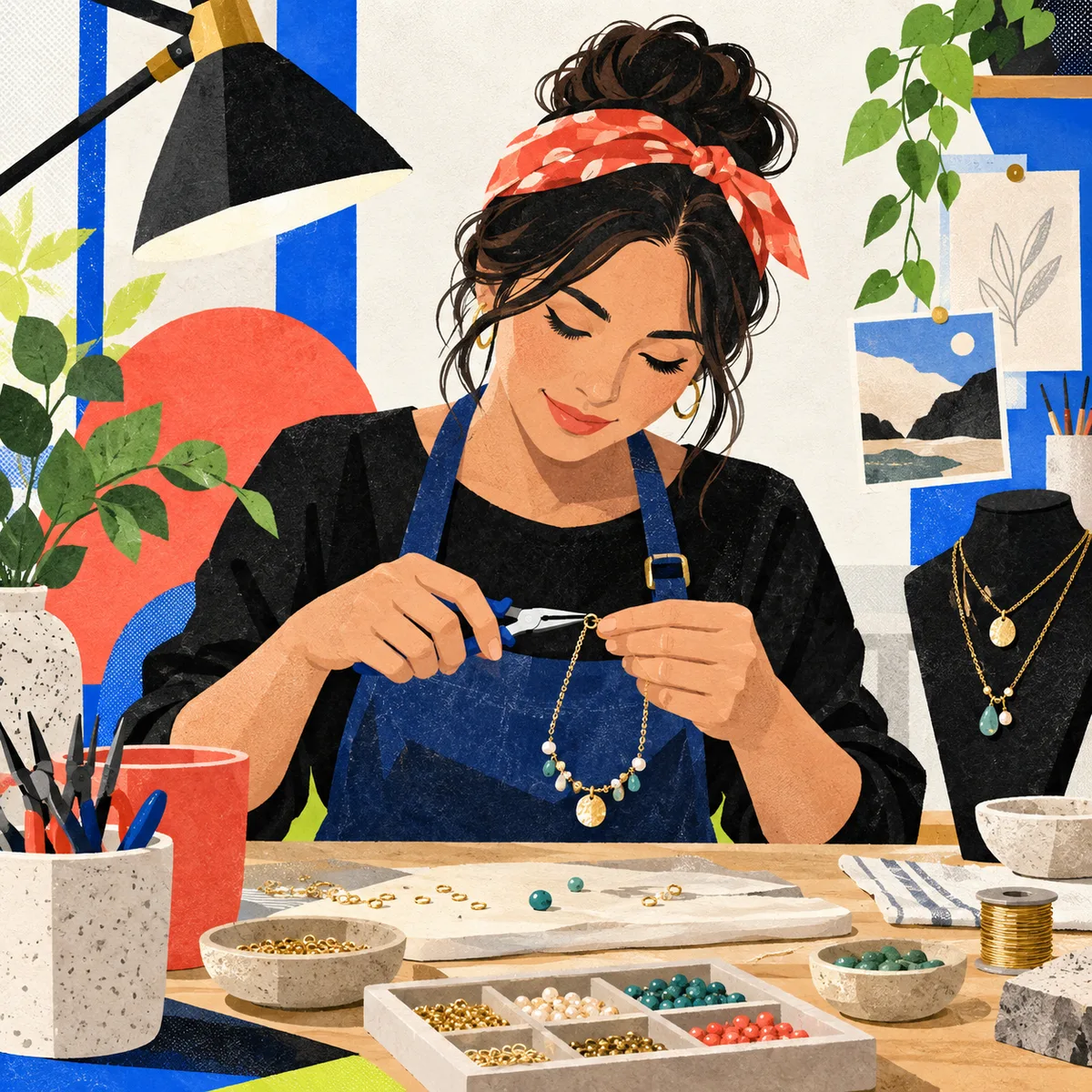
To start a jewelry business, choose a specific product and customer, make safe and repeatable samples, calculate the full cost per item, verify material and marketing claims, and test a small paid collection. Begin with evidence from samples and orders—not a large inventory purchase.
Choose the jewelry business you are actually building
| Model | Core work | Early risk | Useful test |
|---|---|---|---|
| Handmade | Design and production | Labour capacity and consistency | Produce the same design several times and time every step |
| Custom or fine jewelry | Consultation, sourcing and trust | Deposits, specifications and high-value materials | One documented custom process with written approval points |
| Private label | Merchandising and brand | Supplier quality and minimum orders | Independent samples from a small shortlist of suppliers |
| Curated resale | Buying and customer experience | Inventory, authenticity and margin | A narrow collection with traceable invoices |
1. Define the buyer, occasion and price position
“Jewelry for women” is not a useful brief. Define the customer, wearing occasion, material expectations and reason to choose you. A focused opening collection might solve one task—everyday hypoallergenic-looking pieces, personalised gifts or lightweight event jewelry—but every material claim must be accurate and supportable.
2. Produce samples and write specifications
Create a specification for every design: dimensions, weight, materials, finish, stone or component, clasp, chain length, packaging and acceptable variation. Photograph the approved sample and record the supplier or production method. Repeat the assembly process to see whether quality and labour time are stable.
Test wear, closures, edges, colour transfer and packaging. Do not infer safety from appearance. Products intended for children can trigger additional federal requirements; begin with the Consumer Product Safety Commission’s children’s product guidance.
3. Check names, structure and local requirements
Search the proposed brand through the USPTO trademark search system, marketplaces and general web results. Then use the SBA registration guide to identify state and local steps for your chosen structure. Check home-occupation, event-vendor and sales-tax rules where you actually operate.
4. Substantiate metal, gemstone and origin claims
The Federal Trade Commission’s Jewelry Guides address marketing claims for precious metals, gemstones, pearls and related products. Keep invoices, test reports and supplier declarations that support the descriptions you publish. Use plain, precise material wording rather than implying a product is solid gold, natural, handmade, non-toxic or from a particular origin without evidence.
5. Calculate price from the complete item cost
For each item, total materials, findings, packaging, direct labour, outsourced work, payment or marketplace fees, shipping subsidy and a reasonable allowance for defects, returns or remakes. Then calculate:
Selling price − variable cost per sale = contribution available for overhead, tax and profit.
A markup copied from another brand tells you nothing about your labour, channel fees or return rate. Record business transactions separately and review federal basics through the IRS starting-a-business resources.
6. Choose one opening collection and one channel
A small coherent collection is easier to photograph, explain and replenish than unrelated pieces. Choose a channel that fits the product: an owned store, marketplace, local events, wholesale outreach or appointment-based custom work. Each has different fees, customer expectations and return risks.
Your product page should show scale, dimensions, materials, care, production time, what arrives in the package and the return or custom-order terms. Photograph the actual approved sample.
7. Protect the order and custom-design process
For custom work, use a written description of the design, materials, price, deposit, approval stages, delivery estimate, revision limit and cancellation terms. Confirm changes in writing. For higher-value inventory, define access, storage, shipping and signature controls before accepting orders.
8. Test paid demand before expanding inventory
Launch a limited collection or scheduled preorder with honest production dates. Track product-page visits, questions, completed purchases, average production time, defects, returns and repeat interest. A sale that consumes excessive labour or causes frequent remakes is not yet a repeatable product.
9. Scale the constraint, not the catalogue
After repeat sales, identify the actual bottleneck. If production time is the problem, document the process or reduce complexity. If demand is weak, improve the offer and audience before ordering more stock. If the channel is expensive, test a second channel with the same proven products.
For a broader apparel-and-accessories model, use the inventory framework in the home clothing business guide. For online fulfilment without holding stock, compare the trade-offs in the dropshipping guide.
Jewelry business checklist
- A defined buyer, occasion and material position
- Approved samples and written specifications
- Supplier records supporting every material claim
- Brand-name and trademark search
- Registration, home-business, tax and event rules checked
- Complete item-level cost and contribution calculation
- Product pages with dimensions, materials, care and fulfilment terms
- A limited paid collection with measurable results
Frequently asked questions
How much inventory do I need?
There is no universal number. Start from the minimum needed to test a coherent collection and meet the delivery promise. Custom, made-to-order and preorder models may need more samples than finished inventory.
Can I call jewelry hypoallergenic?
Do not make a broad health or material claim without evidence that supports the exact product and wording. Describe verified materials precisely and retain supplier or testing documentation.
Do I need an LLC?
Not every seller needs the same structure. Compare liability exposure, state fees, tax treatment, insurance, partners and sales channels before deciding.
Use these official starting points to verify current rules. The linked agencies cover the United States; elsewhere, check the equivalent national and local authorities. Prices, costs and market figures in this guide are planning estimates unless a nearby citation says otherwise.