Confirm what food you will sell, where it may legally be prepared and how it will stay safe in storage and delivery. Test a narrow menu with paid demand before committing to premises or major equipment.
Food Business Guides
Before you spend money
Use these three questions to turn the guide into a decision, not just a reading list.
- Which food-safety and local permit rules apply to the exact product?
- Can a small menu cover ingredients, labour, packaging and delivery?
- Can you test real paid demand before taking on fixed premises costs?
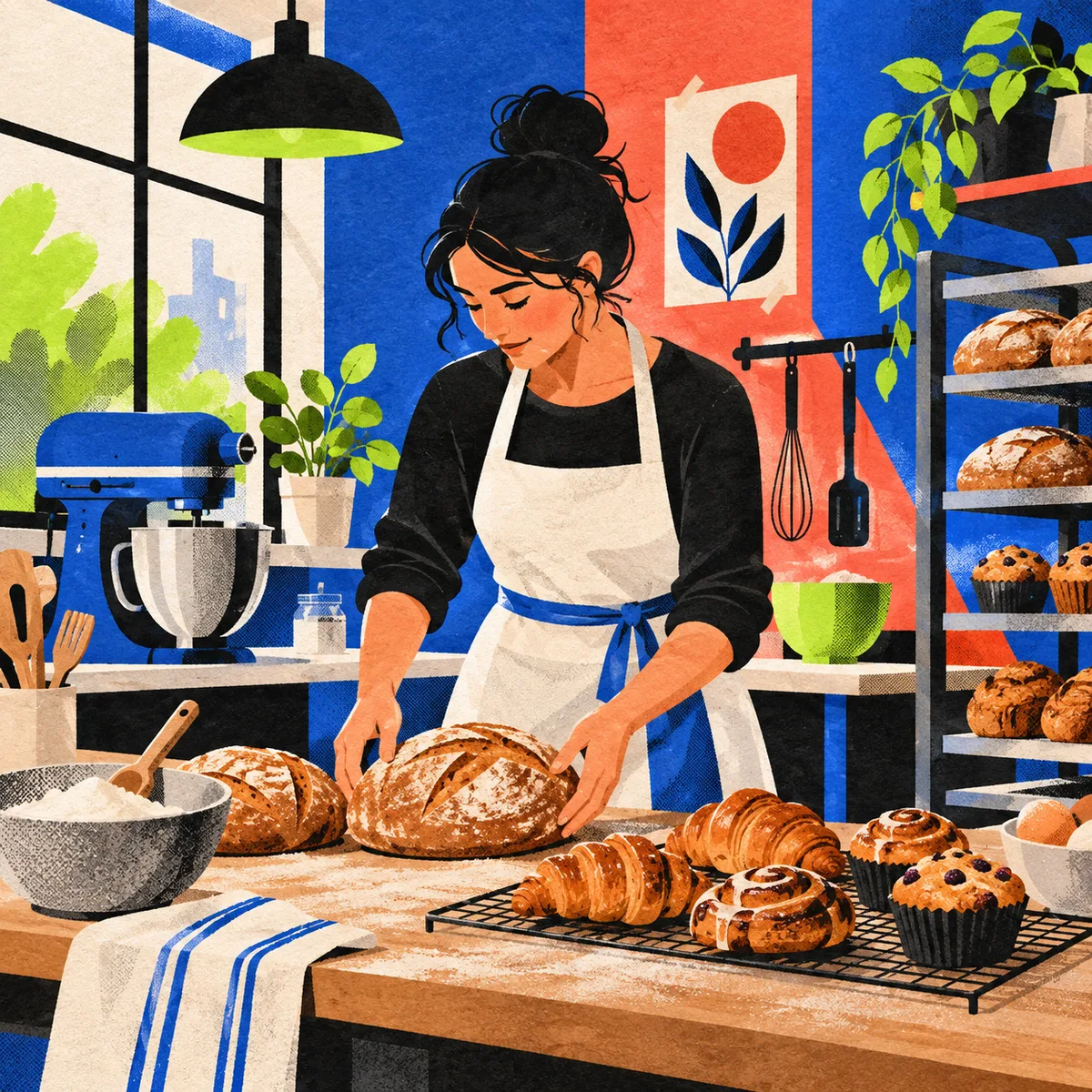
To start a baking business, choose a legal production setting, a small menu and one sales route. Confirm state and local food rules, standardise recipes and allergen information, calculate the complete cost per product, and run a limited paid test before buying commercial equipment or signing a lease.
Choose the legal production model first
| Model | Useful for | Question to resolve before selling |
|---|---|---|
| Cottage food | Eligible shelf-stable products made at home | Which products, channels, labels and sales limits does your state allow? |
| Shared commercial kitchen | Testing broader products without building a facility | Does the kitchen, storage and schedule support your process and permit? |
| Own commercial bakery | Higher capacity and retail or wholesale operations | Can demand support the premises, build-out, equipment and staff? |
| Contract production | Scaling a standard product through a qualified manufacturer | Who controls formula, labels, quality, minimum runs and recalls? |
Home baking is not automatically legal, and a business registration is not a food permit. Start with the agency that regulates production where the food is made.
1. Confirm permitted products and sales channels
Find your state cottage-food or retail-food programme and local health department. Ask about product eligibility, kitchen inspection, food-safety training, pets, water source, storage, labels, delivery, shipping, wholesale and online sales. The FDA’s Food Code is a model used by jurisdictions, but your adopted state and local rules control.
If a product requires refrigeration or careful time and temperature control, do not assume it qualifies for home production. Obtain the answer for the exact recipe and process.
2. Build a small, repeatable menu
Choose products that share ingredients and equipment and can be produced consistently. Write each formula by weight, expected batch yield, mixing and baking process, cooling, packaging, storage and shelf-life assumptions. Record what happens when the batch does not meet the standard.
A menu with many fillings, sizes and decorations can create more complexity than sales. Begin with a small set that you can price, label and deliver reliably.
3. Control allergens and labels
The FDA identifies major food allergens and federal labelling responsibilities in its food allergy guidance. State cottage-food laws may require specific statements, producer information, ingredient lists or permit numbers. Use the rule that applies to your product and sales channel.
Keep ingredient specifications and supplier labels. Prevent cross-contact where possible and do not make “allergen-free,” health or nutrition claims without a process and evidence that supports them.
4. Register the business and check tax requirements
Use the SBA registration guide to compare structure and registration steps, then verify state and local tax treatment of your products. Food-tax rules can differ by item and sales setting. Review federal basics through the IRS starting-a-business resources.
5. Calculate cost per sellable unit
For each product, include ingredients, packaging, direct production and decorating time, kitchen rental where applicable, payment and platform fees, delivery, waste, failed batches and samples.
Selling price − variable cost per sellable unit = contribution before fixed overhead, tax and profit.
Calculate from sellable yield, not theoretical batch size. If a batch produces uneven or damaged units, only the units you can actually sell belong in the denominator.
6. Set order, deposit and cancellation rules
State the order deadline, serving or product specification, pickup or delivery window, deposit, final payment, changes, cancellations and storage instructions. For custom orders, use written approval for design and allergen information. Avoid promising exact replicas when ingredients and handmade decoration naturally vary.
7. Choose one first sales route
Possible routes include direct preorder pickup, farmers markets, permitted events, local delivery, wholesale or an online store. Verify that your production permit allows the route. Model its fees, travel, display time, unsold product and packaging before committing.
8. Run a limited paid menu test
Offer a fixed menu on specific dates with a clear order cutoff and capacity. Track enquiries, orders, production time, ingredient variance, waste, late pickups, delivery problems and repeat requests. Free samples can test flavour; paid orders test the actual offer.
9. Document food safety and traceability
Keep approved recipes, ingredient lots where practical, supplier records, cleaning routines, temperature or process records required by your regulator, customer order details and a complaint process. Know how you would stop sales and contact customers if an ingredient or product were recalled.
10. Expand only after the process works
Add products, equipment, wholesale accounts or a premises when real orders show a repeatable constraint. A commercial kitchen can increase legal capacity but also adds scheduling, transport and storage costs. A storefront adds a different business model, not merely more baking space.
If the concept includes meal production and recurring delivery, compare the operational differences in the meal-prep guide. For events and larger service commitments, use the catering business guide.
Baking business checklist
- Exact production model and regulator identified
- Eligible products and sales channels confirmed
- Standard recipes, yields and quality limits documented
- Ingredient, allergen and label requirements checked
- Complete unit cost and contribution calculated
- Written ordering, deposit, cancellation and delivery rules
- Food-safety and supplier records retained
- A limited paid menu test completed before expansion
Frequently asked questions
Can I sell baked goods made at home?
Sometimes. Cottage-food rules are state-specific and may limit products, labels, revenue, shipping, wholesale or online sales. Confirm the exact product and channel before accepting payment.
Do I need nutrition labels?
Requirements depend on the product, producer and sales channel, and exemptions can have conditions. Ask the relevant regulator rather than assuming a small business is always exempt.
Should I open a bakery storefront?
Not until demand and economics justify the premises. Preorders, markets or a shared kitchen can test products and operations with a smaller fixed commitment.
Use these official starting points to verify current rules. The linked agencies cover the United States; elsewhere, check the equivalent national and local authorities. Prices, costs and market figures in this guide are planning estimates unless a nearby citation says otherwise.